
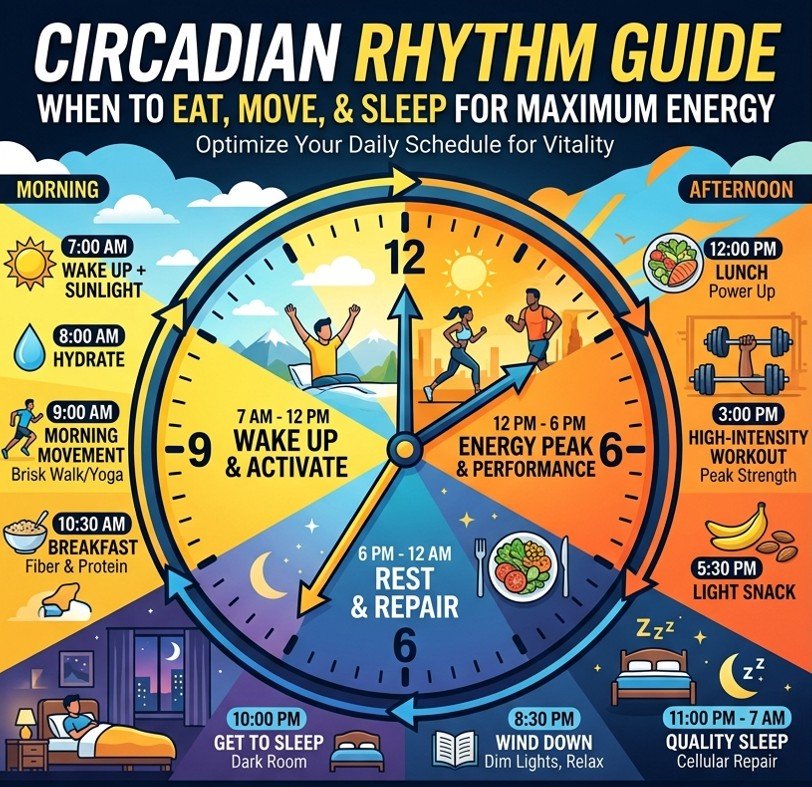
The Circadian Rhythm Guide: When to Eat, Move, and Sleep for Maximum Energy
Ever feel like you’re dragging through your afternoon meetings, only to find yourself wide awake the moment your head hits the pillow? You’re not “broken”, you’re likely just out of sync with your circadian rhythm.
Your circadian rhythm is a 24-hour internal clock running in the background of your brain, cycling between sleepiness and alertness. When you align your lifestyle with this biological metronome, you don’t just feel better; you perform better.
Here is your master schedule for hacking your biology for peak energy.
1. Morning: The Great Reset (6:00 AM – 10:00 AM)
The first few hours of your day set the “anchor” for your internal clock.
- Seek the Light: Within 30 minutes of waking, get 10-15 minutes of natural sunlight. This triggers a healthy spike in cortisol (your “get up and go” hormone) and sets a timer for melatonin production 14 hours later.
- Delay the Caffeine: Wait about 90 minutes after waking for your first cup of coffee. This allows your body to naturally clear out adenosine (the sleepiness chemical) without a mid-morning crash.
- Move Gently: High-intensity workouts can wait. A brisk walk or light stretching tells your body the day has officially begun.
2. Afternoon: Deep Work and Heavy Lifting (10:00 AM – 6:00 PM)
This is when your body temperature rises and your cognitive functions peak.
- The “Deep Work” Window: Schedule your most brain-intensive tasks between 10:00 AM and 1:00 PM. Your focus and logic are at their sharpest here.
- The Movement Sweet Spot: Aim for your hardest workout between 3:00 PM and 6:00 PM. Research shows that muscle strength and lung capacity peak in the late afternoon, and your body temperature is high enough to reduce injury risk.
- The Lunch Strategy: Eat your largest meal at midday. Your insulin sensitivity is higher during the day, meaning your body processes those carbs and proteins much more efficiently than it does at night.
3. Evening: The Wind-Down (6:00 PM – 10:00 PM)
The goal here is to signal to your brain that the sun has “gone down,” even if your overhead lights are still on.
- The Kitchen Closure: Try to finish your last meal at least 3 hours before bed. Digestion is an energetic process; if your stomach is working hard, your brain won’t enter deep sleep properly.
- Dim the Lights: Switch to warm, amber lamps and put the phone away. Blue light from screens mimics sunlight, tricking your brain into thinking it’s noon and suppressing sleep hormones.
- Cool Down: Your body temperature needs to drop by about 2-3 degrees to initiate sleep. A warm shower an hour before bed can actually help. When you step out, your core temperature drops rapidly, signaling it’s time to drift off.
Summary Table: Your Bio-Clock at a Glance
| Activity | Optimal Time | Why it Works |
| Sunlight | 7:00 AM – 8:00 AM | Regulates cortisol and melatonin. |
| Deep Work | 10:00 AM – 1:00 PM | Peak cognitive alertness. |
| Big Meal | 12:00 PM – 1:30 PM | Higher insulin sensitivity. |
| Exercise | 4:00 PM – 6:00 PM | Peak physical performance. |
| Last Meal | 7:00 PM | Prevents digestive sleep disruption. |
The Bottom Line
Consistency is the secret sauce. Try to keep your wake and sleep times within a 30-minute window, even on weekends. Your body craves predictability; give it a steady rhythm, and it will reward you with boundless energy.
Leave a Reply